
Training / Muscle Growth
Training to grow, not just to get tired
How muscle tissue develops, why you should distinguish between heavy and light work, and how to build short sessions for the upper and lower body.
Sometimes the hardest part of a workout begins after the last rep. You rack the barbell, look at your watch, and think: "Is that really it? Maybe I need one more exercise?" In the gym, it's easy to mistake the quantity of work done for quality. Especially when someone around you keeps working out while you are already heading home.
But a muscle doesn't know how much time you spent near the machines. It responds to the work it actually performed. And you don't just live in the gym: you need to sleep, work, move, and train again. A good plan should fit into this life, not demand that your whole life become recovery from it.
This guide is about strength work without chasing mandatory exhaustion. First, we will break down what increases inside the muscle. Then we will move on to short sessions: upper body separately, lower body separately, squat and deadlift on different days. Preparation, work sets, and the lighter variation will be shown separately so you don't have to decipher general advice before a workout.
The goal is to sustainably develop muscle tissue, including its contractile structures. Not just to look bigger after a session and not to set a fatigue record.12
For apparently healthy adults training without anabolic drugs. The tables are intended for mastered exercises. In cases of illness, pregnancy, recovery from injury, or unusual symptoms, consult a doctor.
What actually grows in a muscle
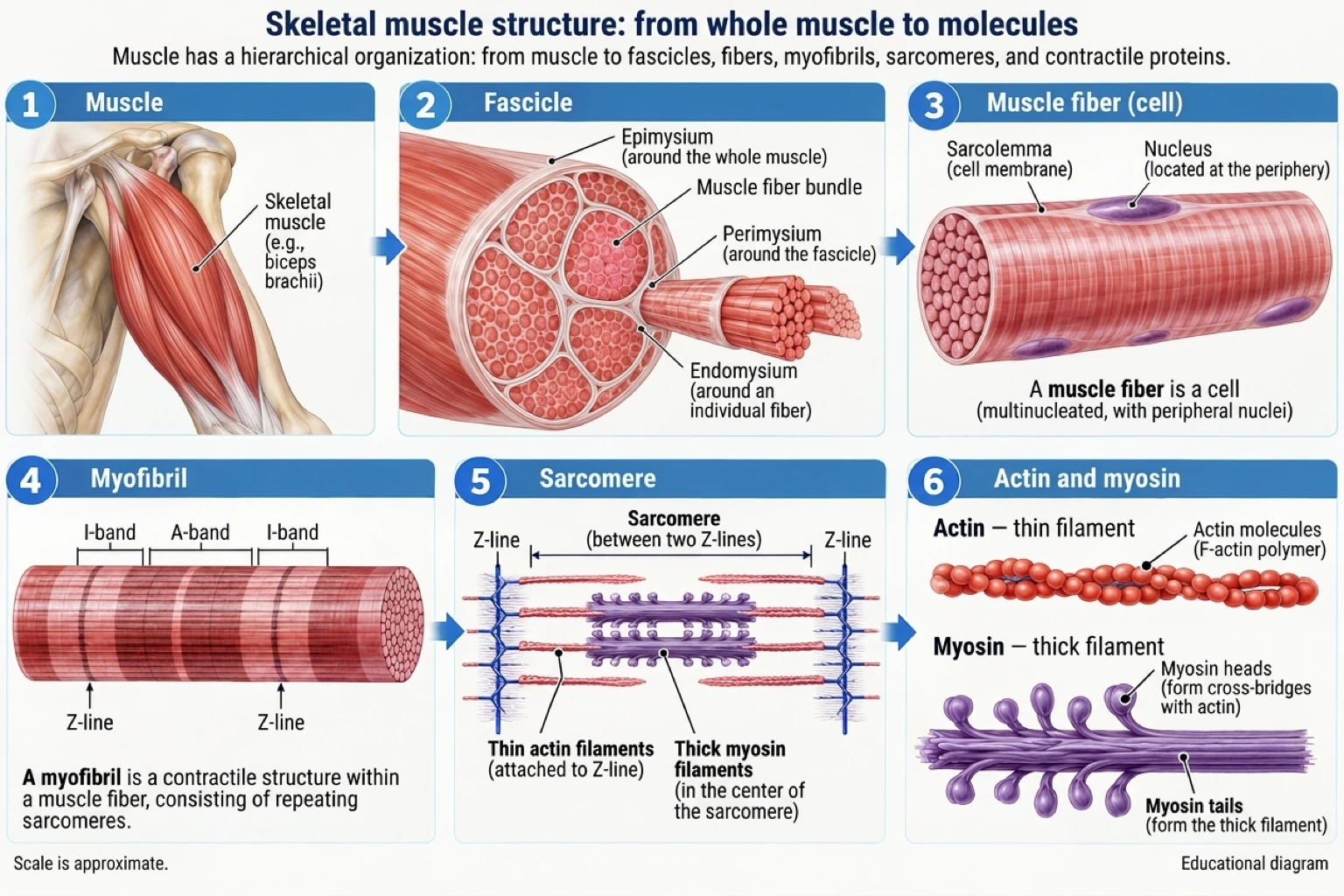
Think of a muscle not as a bag you can fill, but as living tissue with a large number of working elements. It consists of fascicles, and fascicles consist of muscle fibers. Here, the word "fiber" means a long cell. Inside it are myofibrils—structures made of repeating sections, sarcomeres. Within them, actin and myosin interact—the proteins that enable the muscle to generate force.1
When the contractile apparatus develops, a single myosin molecule does not become huge. The number and organization of protein structures inside the cell change. At the same time, protein is constantly renewed: some molecules are broken down, others are assembled from amino acids. If the new ones merely replaced the old ones, renewal has occurred, but there is no net growth yet.13
To increase muscle tissue, it is not enough to accelerate protein production. You need more of it to accumulate over time than is lost.
Therefore, the expression "muscle protein synthesis increased after training" describes only part of the story. Part of the produced material goes to renewal, part goes to recovery from unaccustomed work. A long-term result comes from repeated periods in which the creation and retention of muscle protein allow the tissue to increase.34
How exercise reaches the cell
The barbell creates resistance. The nervous system activates muscle fibers; they generate force, and their structures experience mechanical load. The cell senses this load and changes the processes that regulate protein production. This transition is called mechanotransduction: mechanical stimuli become part of cellular regulation.5
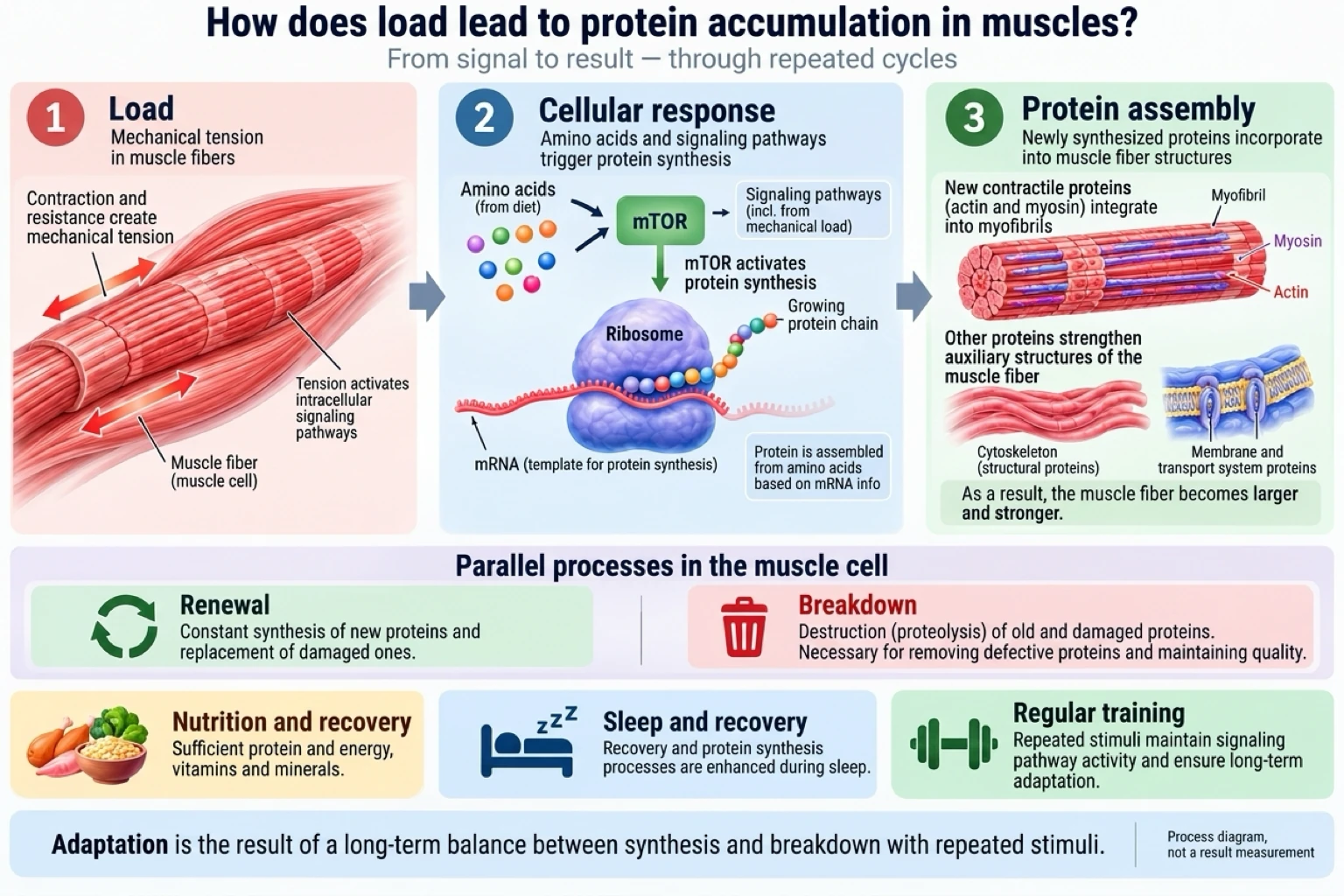
Next, ribosomes go to work—structures where protein molecules are assembled according to information transmitted in RNA. Both the activity of this machinery and its capacity to produce material are important. The mTORC1 complex is involved in regulation, among other things. You don't have to memorize the name: the main thing is that between your rep and new protein, there is a whole sequence of processes, not just a single "growth button."56
The work must be local, and the supply must be systemic. Protein from food is available to the body as a whole, but this does not mean an identical response in all muscles. Exercise changes the response of the specific fibers that worked. Nutrition alone does not replace the bench press, and the bench press alone does not replace sufficient nutrition.2
Strength work can primarily amplify the synthesis of the myofibrillar fraction. Endurance loading may have a stronger impact on other protein systems, including mitochondrial ones. But the direction of adaptation does not mean that only actin or myosin must increase in the cell, and everything else has to remain unchanged.7
Why the pump doesn't answer the question of growth
A muscle can become noticeably fuller right during a session. This is a rapid change in blood flow and fluid. After changing the amount of carbohydrates in your diet, glycogen stores and their associated water change. Swelling can appear after unaccustomed work. All these phenomena are real, but they are not equal to the amount of new contractile protein.48
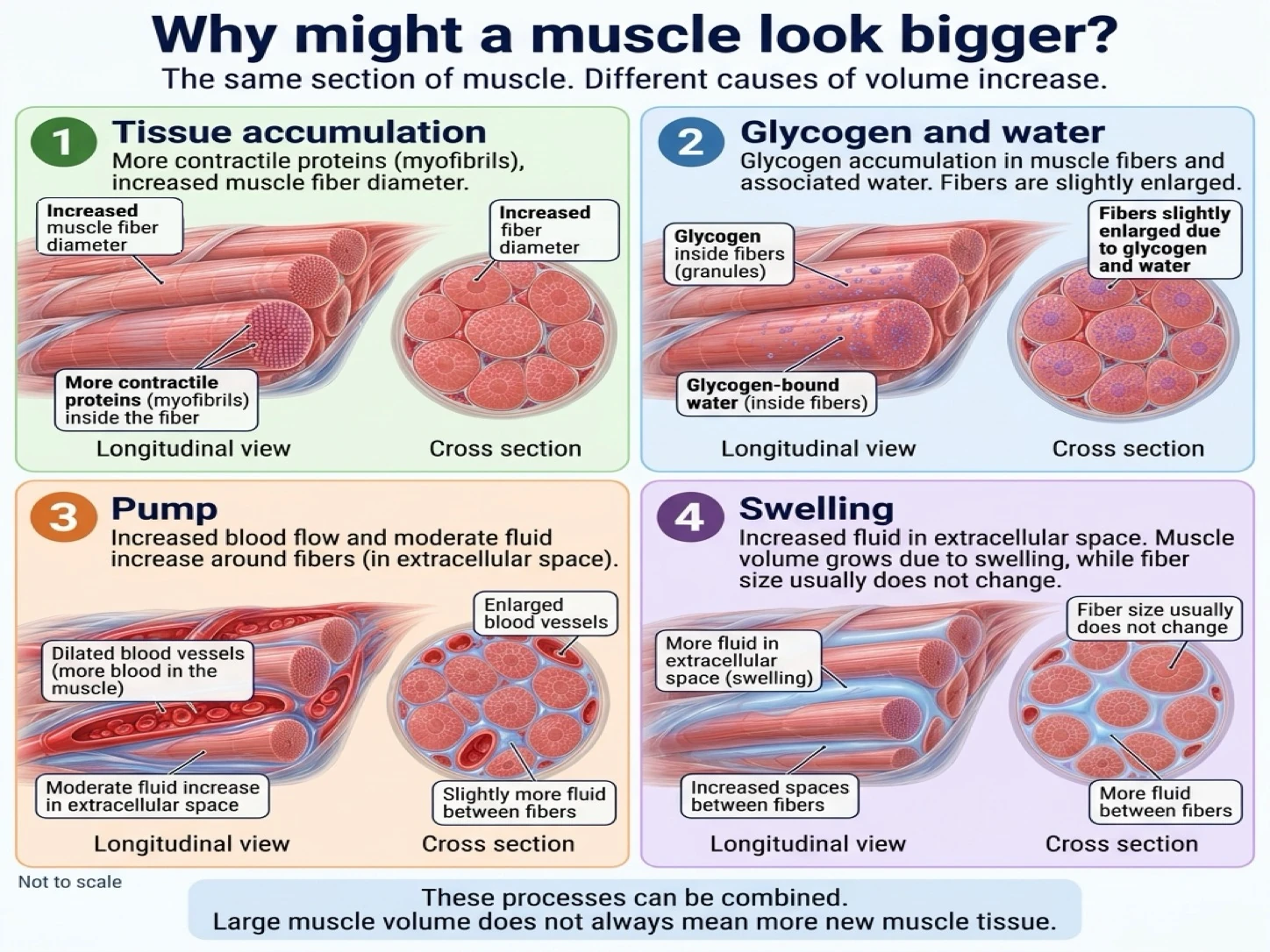
Glycogen is fuel, and mitochondria participate in the cell's energy supply. They don't turn the muscle into a "fake" one. Developing tissue needs both contractile structures and the systems that support their function. A useful goal is sustainable growth, not an attempt to eliminate water and energy supply from the muscle.
There is also no specific rep boundary beyond which work suddenly stops affecting contractile proteins. Different resistances, with sufficient effort, can support their synthesis and increase muscle size. Therefore, a rep range is chosen for the sake of quality execution, not for an imaginary "protein or water" switch.9
Pain shouldn't be turned into a goal
After a new exercise, it can be hard to sit down on a chair the next day. This is not necessarily a sign of a particularly good stimulus. Unaccustomed loading can increase protein turnover because the tissue needs repair. Repairing damage and increasing the total number of working structures are different tasks.4
Keep familiar exercises long enough to learn how to perform and compare them. Do not look every week for a movement that will cause more soreness. A lack of soreness does not devalue a workout; increasing pain, on the contrary, demands stopping the session and seeing a doctor, not more persistence.
Why the squat and dumbbell raise cannot be considered an equal load

After a heavy squat, you want to catch your breath. After lateral raises, your shoulders might get heavily fatigued, although your general condition remains normal. In both cases, the logbook might say "one work set." But this identical entry does not make the work performed equal.
The squat combines leg work with supporting the barbell, torso, and balance. The conventional deadlift makes its own demands on leg and hip extension, grip, and core control. In the bench press, part of the body is supported by a bench. In a lateral raise with moderate dumbbells, the task is much more localized. Under certain comparable conditions, the squat and conventional deadlift elicit higher oxygen consumption, heart rate, and energy expenditure than the bench press.10
Counting sets is useful. Counting them as identical units of whole-body fatigue is not. Alongside the amount of work, you need the name of the exercise, the resistance, proximity to failure, rest periods, and how you tolerate the session as a whole.
This explains why a short leg workout sometimes feels heavier than a longer arm workout. But that doesn't justify a universal rule like "rest two weeks after any conventional deadlift." The return of performance capacity, the disappearance of soreness, and the shift in protein metabolism do not run on the same timer. The exact same exercise can also be performed completely differently: calmly leaving some reps in reserve or finishing several sets at the limit.1112
In practical terms, the squat and deadlift are separated below. This is a way to limit the combination of demanding movements in a single session, not a ban on using them together in any other program. If another routine already suits you and yields results, this text in itself doesn't require you to abandon it.
Two observations instead of one sum
After a workout, separately note down how you performed the main exercise, and separately—how heavy the entire session turned out to be. For example: "Squat—movement stable, had about three reps in reserve. Workout overall—normal." Or: "Shoulders worked fine, but general weakness was unusual."
In the second entry, there is a reason to look into your condition. This is more useful than automatically adding rest days just because of the name of the muscle. The nervous system participates in every movement, but the sensation of a heavy barbell is not a diagnostic test for it.1122
First learn the movement—without a willpower test
A beginner initially has to think about almost everything: where to place their feet, how to grip the bar, where to finish the descent, and how to return the weight. There is no need to add an obligatory struggle for the last rep to this task.
Start with a qualified trainer and a few suitable movements. Get a demonstration, perform the exercise with a manageable resistance, analyze your mistakes, and repeat it at another session. A habit doesn't come from a single successful explanation, but from returning to a familiar task.13
Good signs of progress are simple. You reproduce the setup without constant prompting. You don't search for the bar path anew with every rep. You notice a loss of points of contact. You understand how to end a set before an unsafe change in movement occurs. You can repeat this not just right after a demonstration, but on another day as well.
Automaticity is a familiar movement, not switched-off attention. Under heavier resistance, control needs to be checked again. What comes easily with an empty bar is not permission to immediately seek your limit.
The learning period does not equal a single introductory week. Its duration depends on the skills, exercises, and capabilities of the individual; there is no identical mandatory timeframe in months for everyone. Resistance can be gradually increased as long as the movement remains controllable. At the same time, intentional failure is not mandatory either in the first year or later on.1314
The workout cards below are intended for already mastered variations. If you cannot yet perform the conventional deadlift with stable form, the presence of card B4 does not make it your next heavy exercise. First, you need instruction or an agreed-upon substitution; someone else's calendar is not more important than this condition.
A heavy session is not an attempt to max out
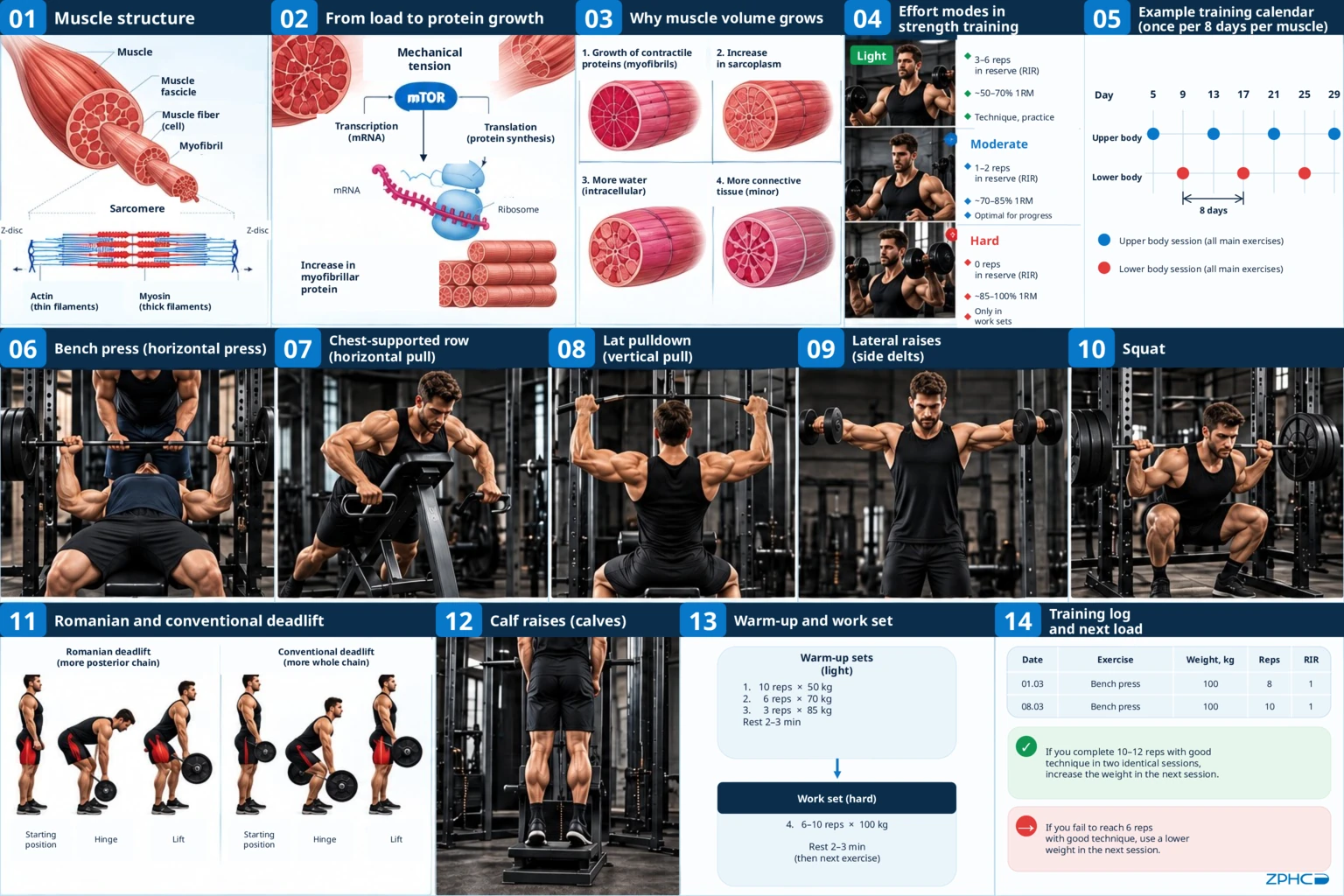
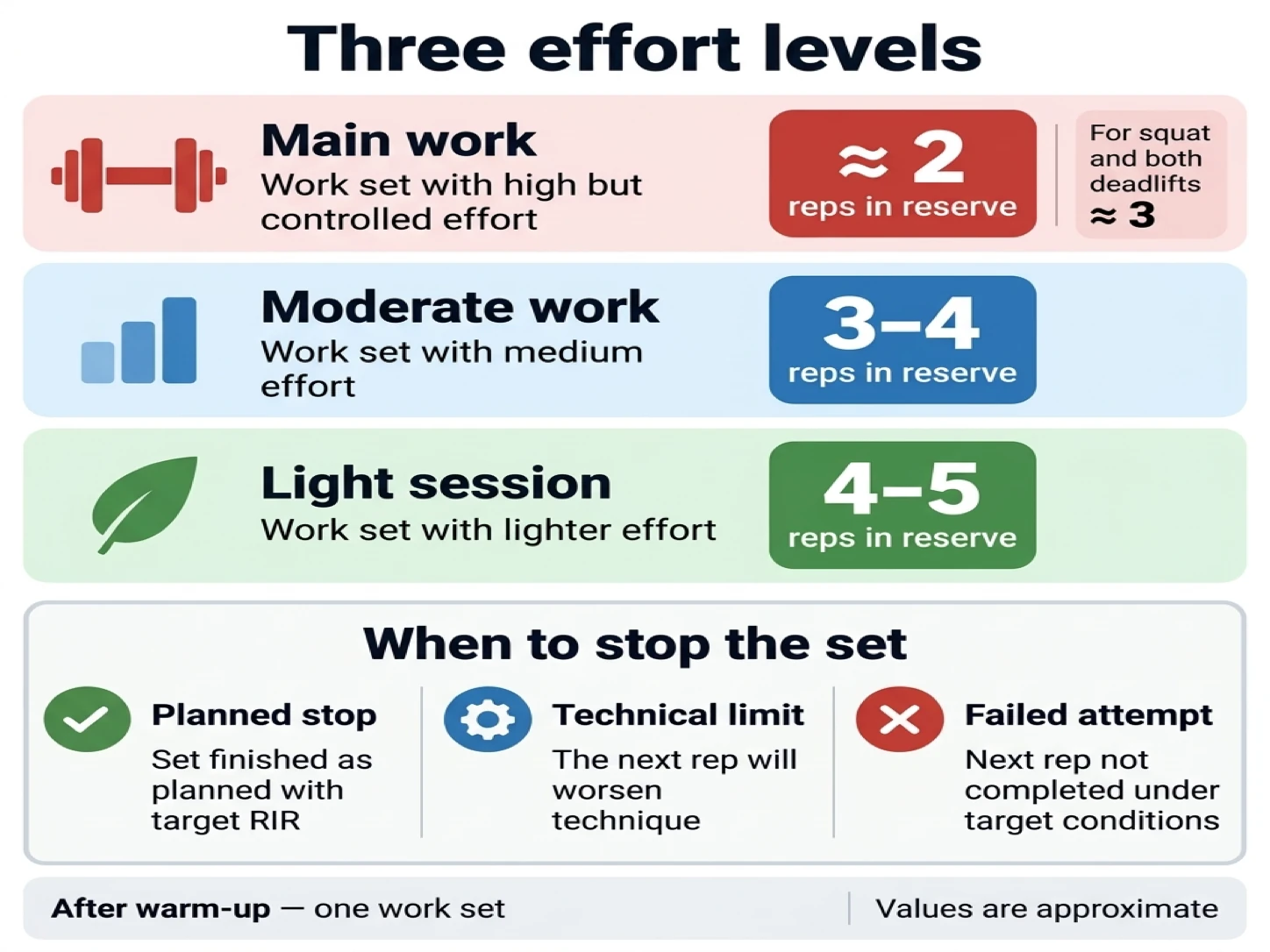
The word “heavy” has several meanings. Heavy weight, few reps in reserve, and high full-body fatigue are different things. To execute the plan without guesswork, we will distinguish between main, moderate, and light work.
| Mode | How to perform | What not to do |
|---|---|---|
| Main work | The prescribed work set; usually about two full reps in reserve, in the squat and deadlifts — about three | Do not turn the last rep into a test of your max |
| Moderate work | The same rep range, but the resistance is selected so that about 3–4 reps remain in reserve | Do not treat a lighter weight as an excuse to push the set to the limit |
| Light session | One set per exercise with about 4–5 in reserve; the weight is lighter if necessary for this task | Do not add new exercises and do not shorten rest |
These values are working guidelines, not exact biological boundaries. In a short plan, one work set is already prescribed, so when lightening the session, its difficulty is reduced first, rather than dropping the set count below one. Warm-up sets are kept as needed.
What it means to “leave two reps”
After the last planned rep, you estimate that about two more identical movements could have been completed. With the same points of contact, range of motion, and without assistance. Not two bounces and not two partial reps.
This is an estimate. It is possible to be off, especially in an unfamiliar exercise or a high-rep set. Therefore, recording “about two” is normal, and “not sure” is more useful than false precision. The goal is neither to declare any unpleasant sensation as your limit, nor to verify the estimate with a failed rep.1516
To enter the proposed rotation, use the moderate mode. Choose the main mode when the movement and your tolerance remain stable. The light mode is needed based on your condition, not as a mandatory tax for every heavy workout. Maintain the exact same technique: a lighter day should not become a day of sloppy reps.
If you reduce the weight and still lift to absolute failure, you will get another heavy set, not rest. Reducing effort has independent value; sets to failure can cause greater acute fatigue than work with a small reserve.1214
Short sessions: upper and lower split
What follows is one specific organizational option, not a mandatory program for everyone. It is suitable to discuss with a coach for someone who has already mastered the movements and prefers short split sessions. Here there are four exercises for the upper body and two for the lower. After warm-ups — one work set of each.
The workload is low. It may not be enough for noticeable new growth, especially for a person with extensive training experience. Therefore, this option cannot be considered a proven minimum or a program for maximal development of every muscle. It only makes sense alongside tracking results and being ready to change the frequency, number of sets, or exercise selection.171826
Two alternating rotations
The upper-body sessions cycle through A1 → A2 → A3 → A1. The lower-body ones — B1 → B2 → B3 → B4 → B1. Alternation is maintained between them: after upper — lower, after lower — upper. The number of the next upper card does not depend on the number of the lower one.
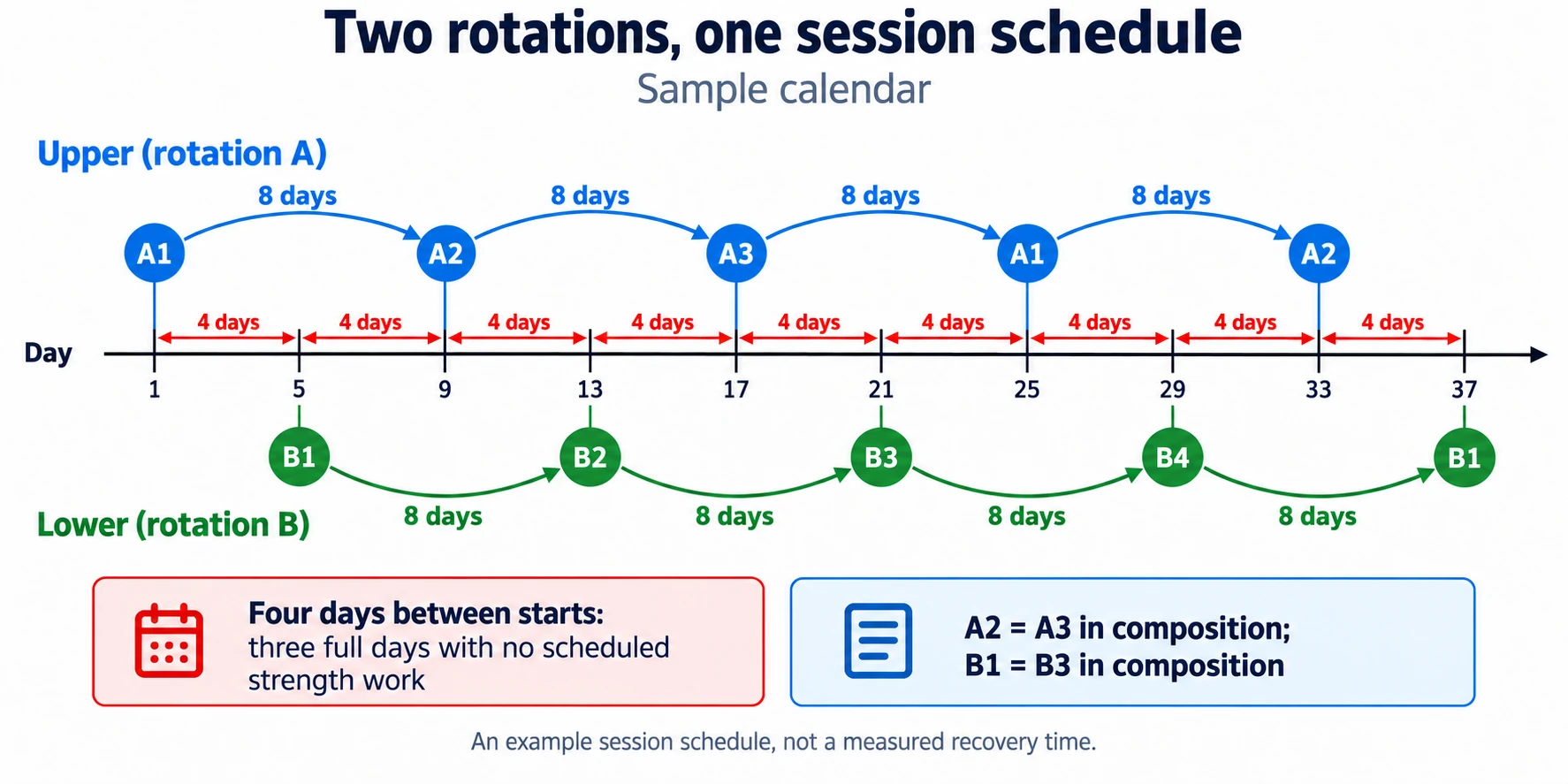
A2 and A3 have the same exercises. This is an intentional repetition of a familiar option, not a requirement to use more weight or push closer to failure the third time around. Likewise, B1 and B3 repeat the squat. The number next to the letter indicates its place in the rotation, not the level of difficulty.
In the calendar shown, there are four days between the starts of the sessions: a workout, then three full days without prescribed strength work. This is a selected schedule example, not the measured recovery time for all muscles. It results in repeating the upper and lower body every eight days, averaging slightly less than two visits per seven days.
| Day from start | Card | Main focus in the session |
|---|---|---|
| 1 | A1 | Horizontal press, chest-supported row, shoulders, barbell curls |
| 5 | B1 | Squat and calf raises |
| 9 | A2 | Incline press, lat pulldown, shoulders, dumbbell curls |
| 13 | B2 | Romanian deadlift and calf raises |
| 17 | A3 | Repeat of the A2 lineup |
| 21 | B3 | Repeat of the squat and calf raises |
| 25 | A1 | Return to the horizontal press and chest-supported row |
| 29 | B4 | Conventional deadlift and calf raises |
| 33 | A2 | Continuation of the upper-body rotation |
| 37 | B1 | Start of the next lower-body cycle |
Skipping a session does not reset the rotation. If you had to postpone a session, perform the next card when it is appropriate and shift the calendar from there. Do not compress missed work into a single evening. The rules for choosing the main, moderate, and light modes are given below.
What this calendar means for individual exercises
The squat is repeated every 16 days. The Romanian deadlift and conventional deadlift — each every 32 days. The horizontal press and chest-supported row — every 24 days. The incline press and lat pulldown alternate intervals of 8 and 16 days. Shoulders, arm curls, and calves get their exercises every 8 days.
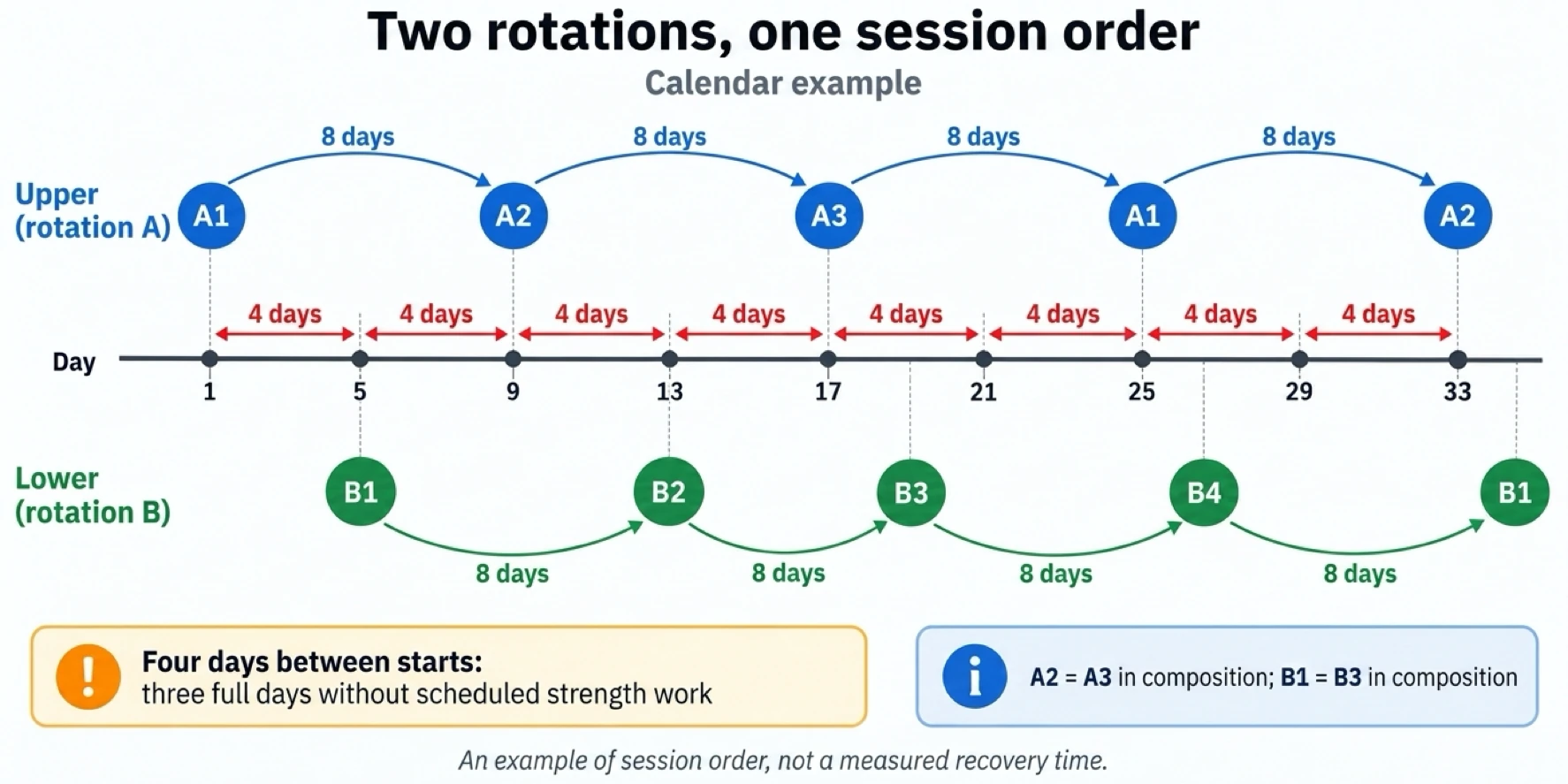
This does not mean that the legs do not work at all between two Romanian deadlifts. But the squat and conventional deadlift are not exact replacements for every one of its tasks. The infrequent repetition of a specific exercise and the lack of load on a muscle are not the same thing.
Such a rotation is not suitable for everyone: you revisit individual movements so infrequently. For learning technique from scratch, confidently assessing progress specifically in the deadlift, or more rapidly increasing training volume, it is usually wiser to reduce the number of alternating options. If after every return you are searching for your bar path all over again, stick to one mastered option with your coach, rather than defending variety for the sake of a spreadsheet.
Upper-body sessions
Start with the press, then perform the row, followed by shoulders and arm curls. This way, the main pressing and pulling work is done before directly fatiguing the arms. There is no separate triceps extension in this short routine: it is involved in the presses. This is a choice of a limited catalog, not proof that isolation work is always redundant.19
All the cards below show the main mode. In moderate mode, leave 3–4 repetitions in reserve; in light mode, 4–5, keeping one work set and the rep range. When first performing an unfamiliar combination, choose the moderate mode. Warm-ups are not included in the number of work sets.
A1. Horizontal press and chest-supported row
| Exercise | Work set | Reps in reserve | Rest |
|---|---|---|---|
| Bench press | 1 × 8–12 | About 2 full reps | About 3 minutes |
| Chest-supported row | 1 × 8–12 | About 2 | About 3 minutes |
| Lateral raises | 1 × 12–20 | About 2 | About 2 minutes |
| Barbell curls | 1 × 10–15 | About 2 | Work finished |
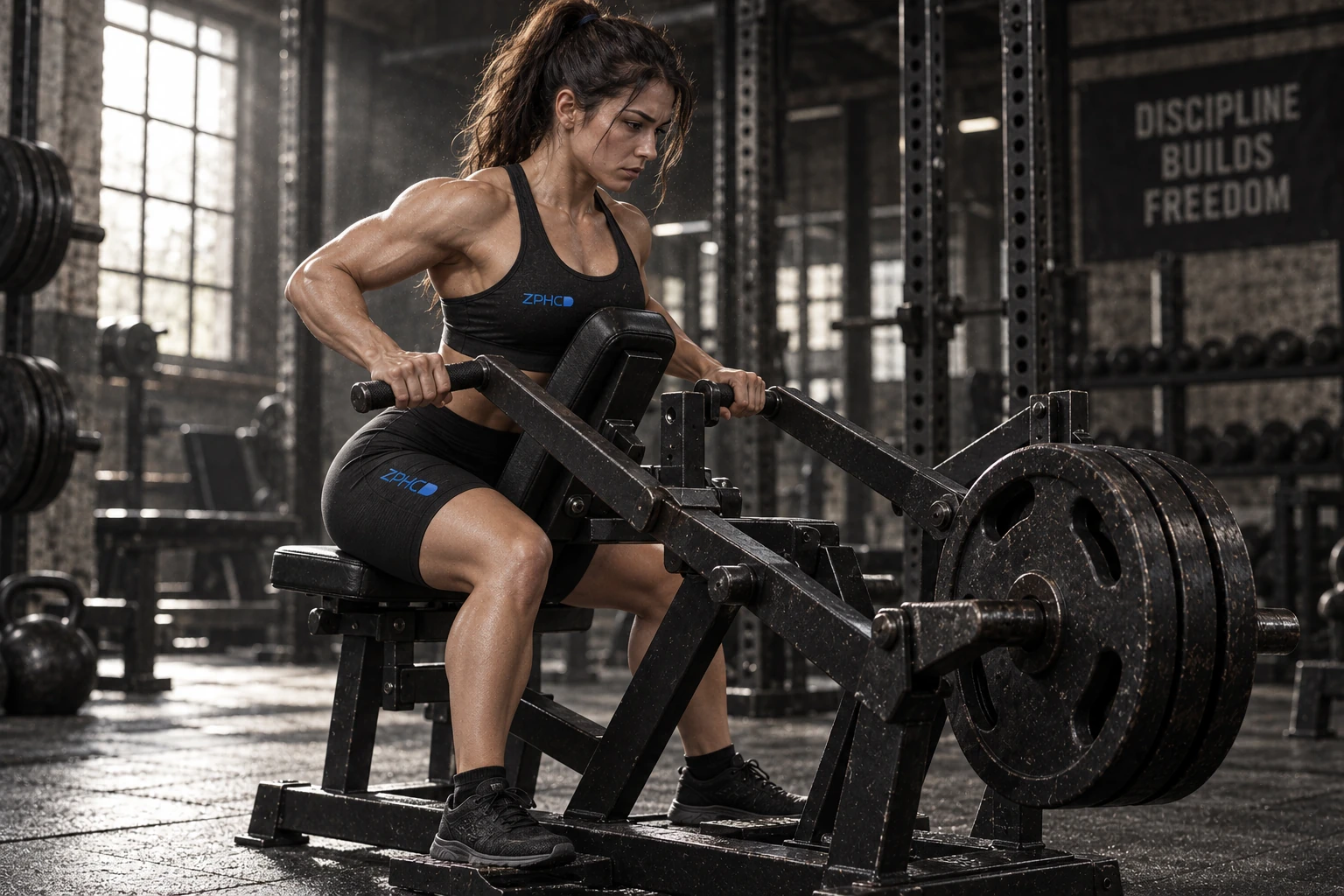
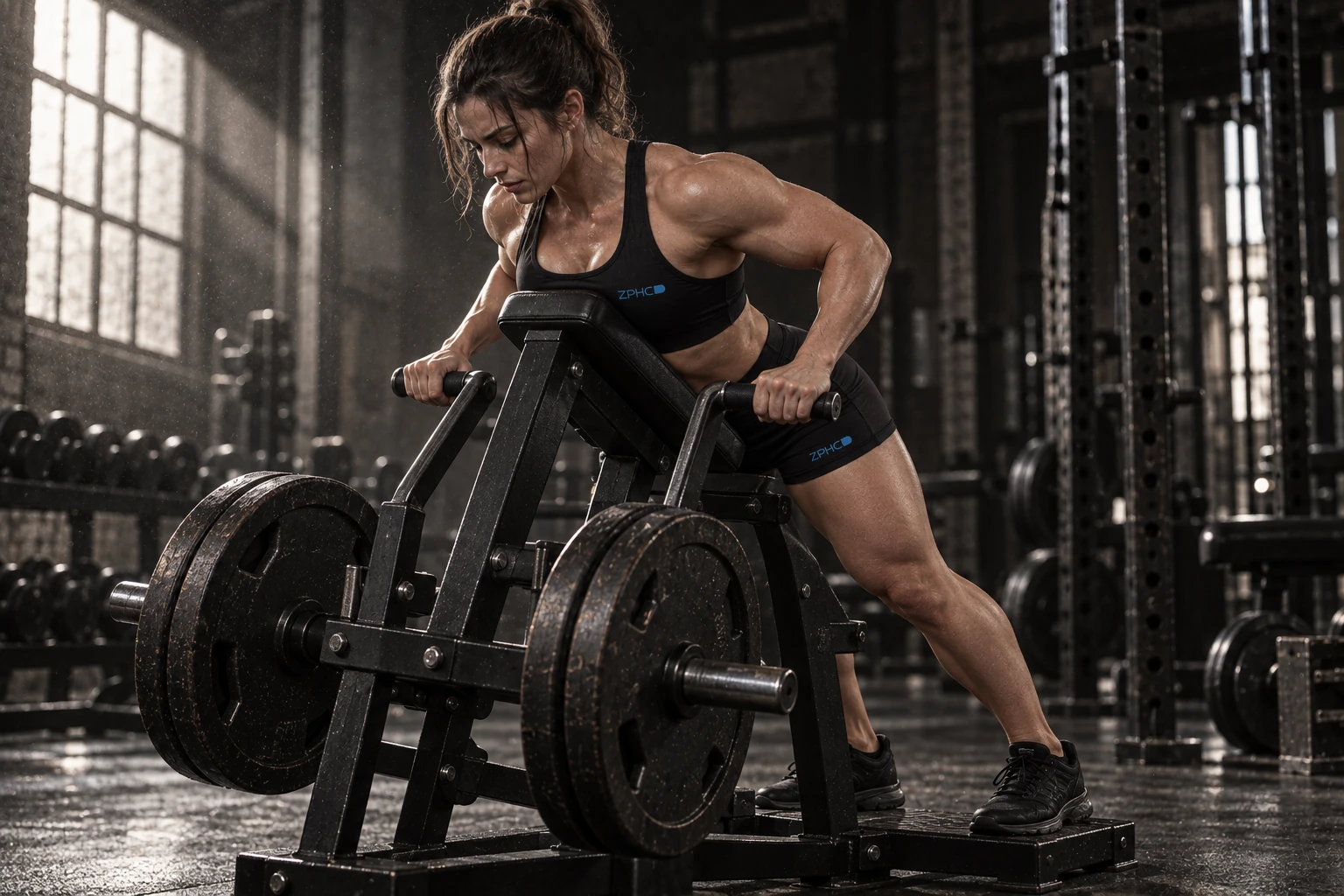
After the press, do not move on to the row without checking its settings and doing a light warm-up set. Rest between exercises and preparation for the next movement are different things. If your breathing still interferes with stable execution, take more time.
The straight bar is kept as the chosen curling option. Your wrists should be comfortable. Do not endure pain just for the sake of this line: agree on a different bar or dumbbells and keep a separate record. The straight bar itself does not guarantee greater forearm growth.
A2 and A3. Incline press and vertical pulldown
| Exercise | Work set | Reps in reserve | Rest |
|---|---|---|---|
| Incline bench press | 1 × 8–12 | About 2 full reps | About 3 minutes |
| Lat pulldown | 1 × 8–12 | About 2 | About 3 minutes |
| Lateral raises | 1 × 12–20 | About 2 | About 2 minutes |
| Dumbbell curls | 1 × 10–15 | About 2 | Work finished |
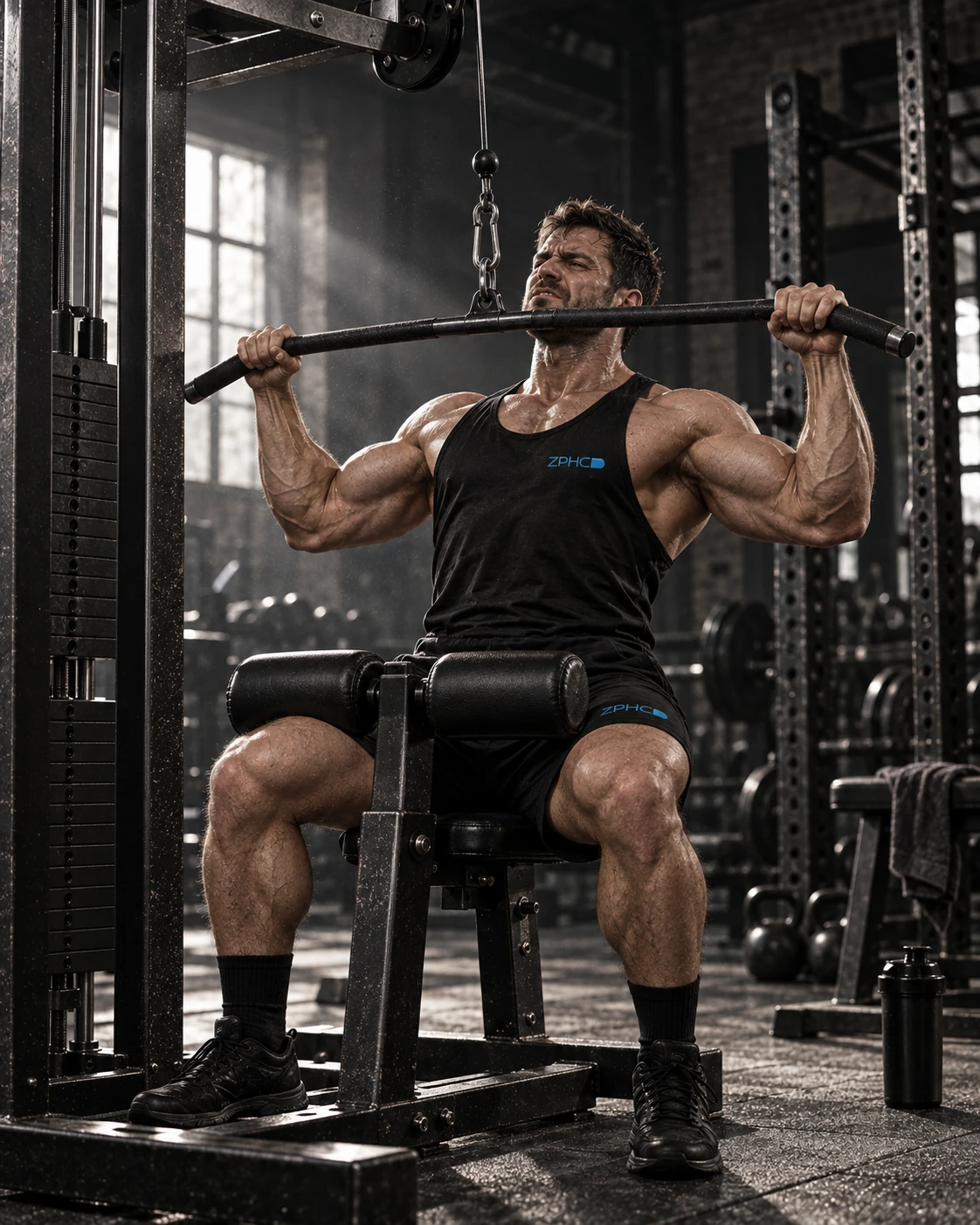
Choose one moderate bench incline and record the position. Do not increase it little by little from workout to workout while still considering the exercise the same. Compare the incline and horizontal presses separately; identical kilograms do not make them the same task.
A3 repeats A2 entirely. With the same order, equipment, and mode, the records of these two cards can be compared. Lateral raises and curls also remain the same mastered movements. In alternating curls, the number of repetitions applies to each arm. Dumbbell weight is recorded for a single dumbbell.
A short list does not mean equally complete work for all muscles
Presses load the pectorals, anterior deltoids, and triceps. Pulls involve several back muscles and the elbow flexors. The lateral raise targets a different function for the shoulder. However, a single movement does not necessarily develop all parts of the involved muscles equally.19
The horizontal and vertical pulls are spaced out here so as not to make the upper-body session longer. The cost of this decision is the infrequent repetition of the horizontal row. If the upper back specifically or its individual regions become a priority, this frequency and the amount of work need to be reconsidered, rather than assuming that the deadlift in the lower-body card has already taken care of everything for them.
Leg sessions: one main movement per visit
You don't need to add heavy squats after deadlifts or deadlifts after squats to a lower-body session just because the routine has few lines. A single main focus has been deliberately chosen here. After it comes direct calf work.
This is a very small selection, not a full leg specialization. The squat effectively loads a number of thigh and glute muscles, but doesn't promise equal growth across the entire hamstring group or every part of the quadriceps. The Romanian deadlift complements it with hip extension; there is no isolated knee flexion in this variation.2021
B1 and B3. Squat
| Exercise | Work set | Reps in reserve | Rest |
|---|---|---|---|
| Squat | 1 × 6–10 | About 3 full reps | 3–5 minutes before the next exercise |
| Calf raises | 1 × 12–20 | About 2 | Work set completed |

Before the squat, separately prepare the movement and the resistance. The first working weight should match the chosen reps in reserve: this is not the absolute heaviest weight you can lift six times. If the sixth rep has already forced you to break form, that weight does not match the assignment.
B2. Romanian deadlift
| Exercise | Work set | Reps in reserve | Rest |
|---|---|---|---|
| Romanian deadlift | 1 × 8–12 | About 3 full reps | 3–5 minutes before the next exercise |
| Calf raises | 1 × 12–20 | About 2 | Work set completed |
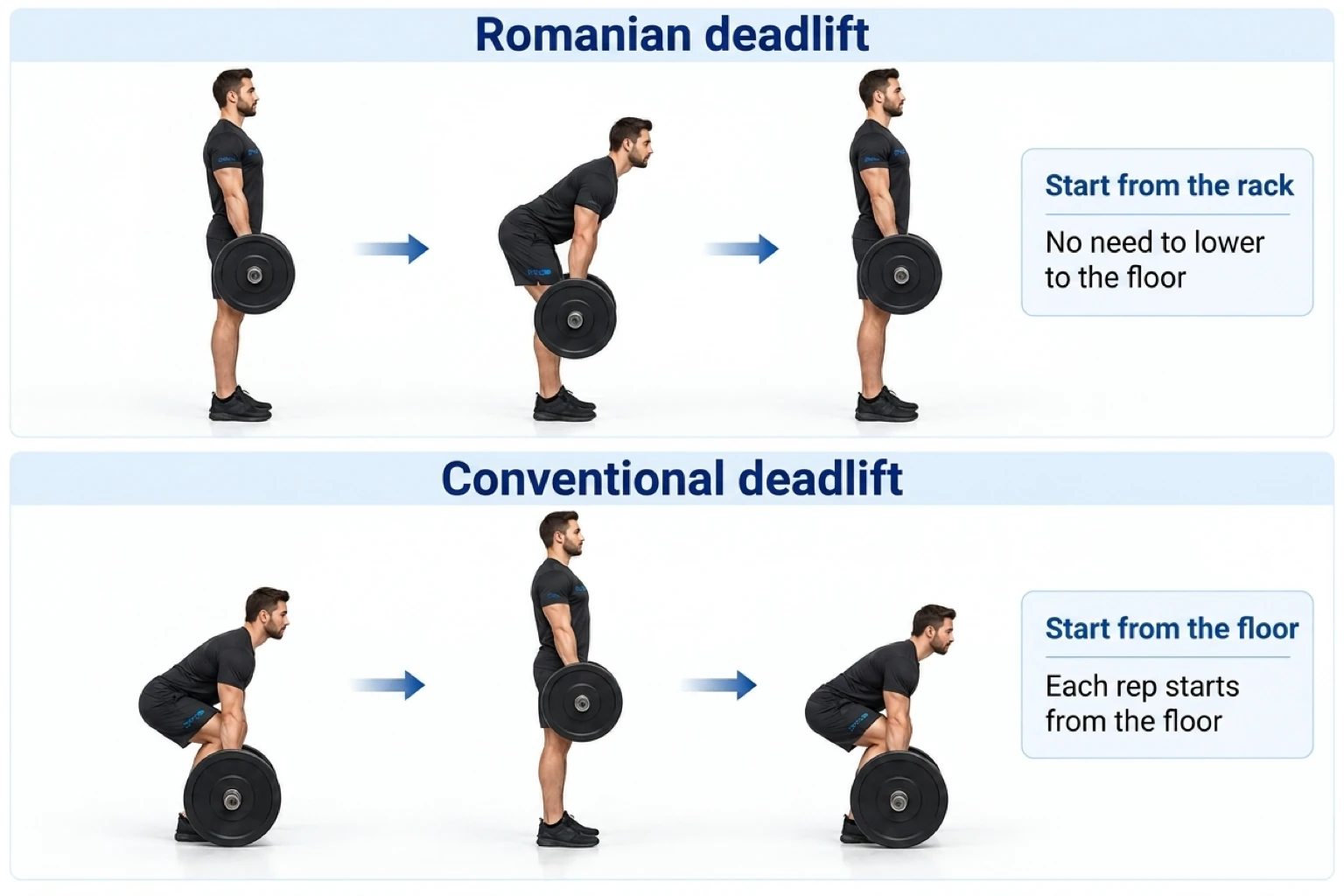
The Romanian deadlift has its own bottom position: it is determined by a stable hinge and the individual's mobility, rather than a mandatory touch of the floor. The result counts as long as the range of motion is maintained. Extra inches gained by losing torso control do not make the set any better.
B4. Conventional deadlift
| Exercise | Work set | Reps in reserve | Rest |
|---|---|---|---|
| Conventional deadlift | 1 × 5–8 | About 3 full reps | 3–5 minutes before the next exercise |
| Calf raises | 1 × 12–20 | About 2 | Work set completed |
A shorter set was chosen to manage execution, not because the fifth rep has some special protein-building effect. Return the bar to the floor under control, reset your starting position, and only then begin the next pull. Do not bounce the bar to extend the set. Intentional failed reps are not programmed in this routine.
The Romanian and conventional deadlifts remain distinct exercises. Do not automatically transfer the weight from one to the other. If one variation is mastered but the other is not, alternating them is not more important than learning. For regular training, you can settle on one variation instead of rotating them, but this substitution needs to be established rather than done randomly based on your mood.
Why calves also need a short prep
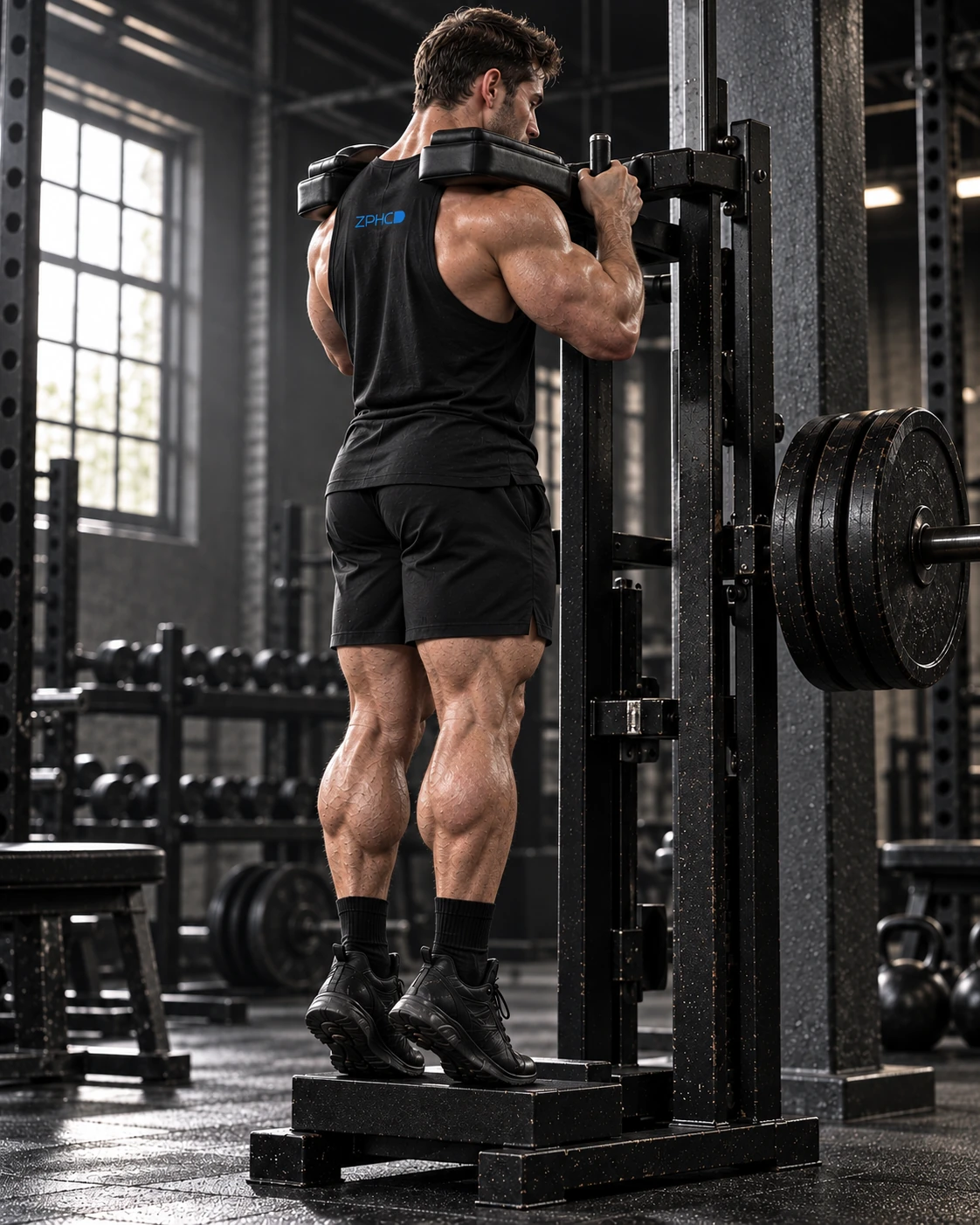
After squats, the body is already warmed up, but the calf raise requires a different range of motion and a different base of support. Before the working resistance, perform 8–12 smooth raises with no added weight or with light resistance. If there is a significant jump in load, add another 3–5 light reps with an intermediate weight. This is a short movement check, not a separate heavy workout.23
Maintain a secure base of support, do not bounce, and do not make the reps progressively shorter. Pain in the Achilles tendon or foot is a reason to stop and investigate, not a signal to stretch harder. Do not place a heavy barbell on your shoulders for calves if you lack the proper setup and a mastered way to finish the set.
Warm-up: a few steps to the work set, not another workout
One work set doesn't mean you walk into the gym and immediately grab the working barbell. Preparation is needed to recall the movement, check the equipment, and gradually build up to the resistance. But it doesn't get better just because it takes more time.24
For the first main exercise, you can use two light sets and one short feeder set. With a heavy working weight or the need for a smoother transition, preparation can expand to 2–4 light and 1–2 short feeder sets. This is a range of possible preparation, not an obligation to hit the upper limit every time.
| Step | What to do | What to watch for |
|---|---|---|
| 1. Light reps | 8–10 smooth reps with plenty in reserve | Settings, points of contact, comfortable range of motion |
| 2. Add a little | 4–6 reps with slightly more weight | Whether the original movement is maintained |
| 3. Briefly feel the resistance | 2–3 reps with a weight closer to the working weight | Control without a long, fatiguing set |
| 4. Rest | About 3 minutes; longer if necessary | Readiness to calmly start the work set |
| 5. Perform the work set | One set from the routine with the specified reps in reserve | Rep quality and a clear stopping point |
The numbers provided are practical steps, not a universally perfect warm-up. If the working load is not yet known, it should be dialed in during the learning phase first. Do not use the warm-up for a series of unexpected one-rep max tests.
An example you can picture in the gym
Let's say you confidently bench press 60 kg in your working range. Today, your prep might look like this: the 20 kg empty bar for 8 reps, then 35 kg for 5, then 50 kg for 2–3. Between the light sets, calmly catch your breath; before the work set, rest for about three minutes. After that, perform one work set with 60 kg and the required reps in reserve.
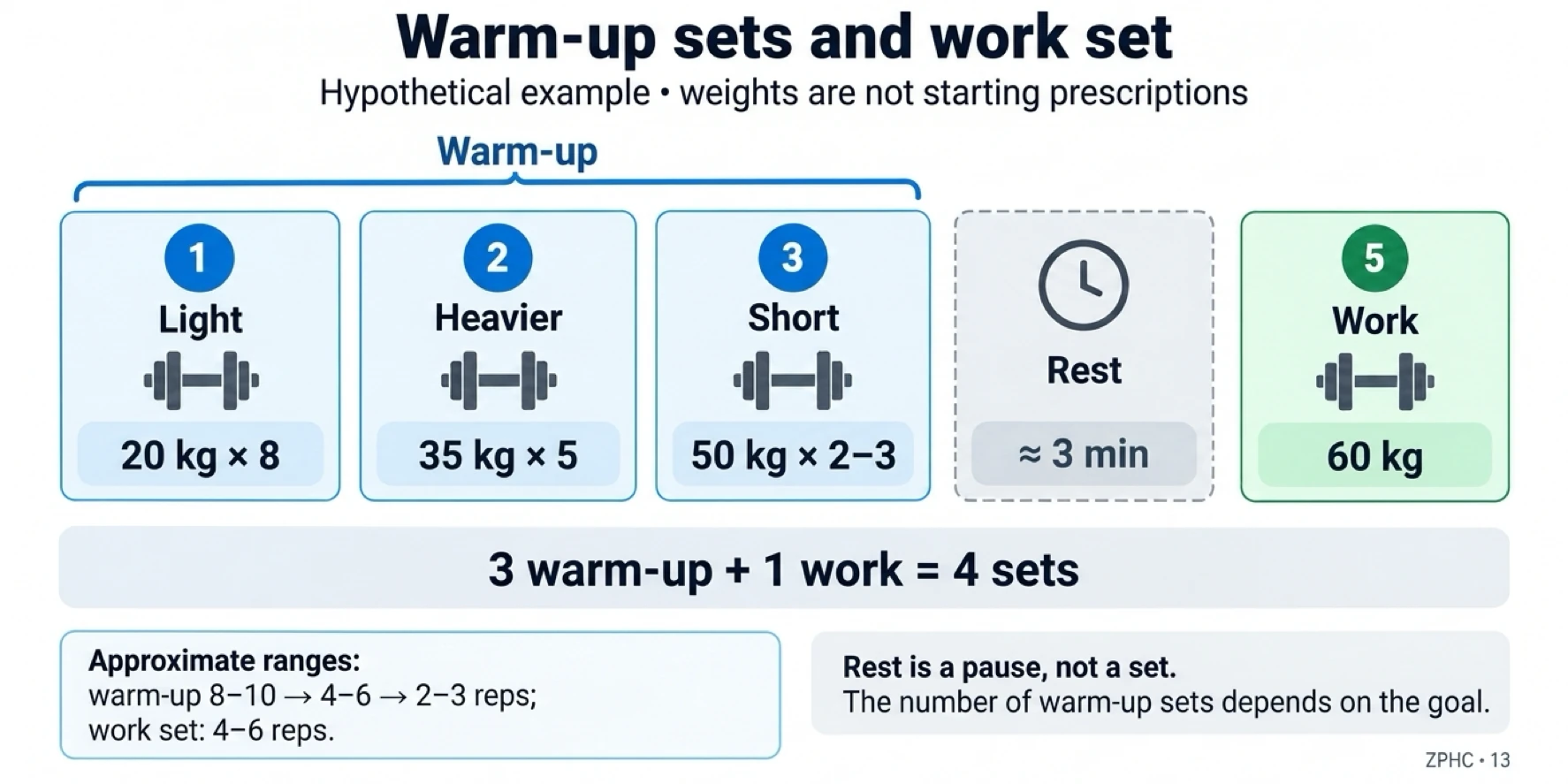
That makes four sets in total, but only one is a hard work set. These weights are hypothetical. For some, the empty bar is already too heavy, while for others, the transition will require extra steps. The principle is to approach the working weight without accumulating unnecessary pre-fatigue.
If the final feeder reps are unexpectedly heavy, check the resistance, the settings, and how you feel. Sometimes it makes sense to reduce the planned working weight. There is no need to automatically perform another long set with six reps in reserve just to "prime" the body: no such separate step is prescribed here.
Do all exercises require the same number of sets?
No. A new bench press, squat, or deadlift needs its own build-up. Before the second major exercise, part of the general warm-up has already been done, but its grip and bar path still need to be checked. Usually, fewer short sets are enough for this compared to the beginning of the session; the exact number depends on the movement and the resistance.
Before lateral raises and curls, start with one light set of 8–12 reps. If the resistance or movement path is still unclear, add a short step. You don't need to do forty to sixty prep reps just for the feeling that the muscle has finally "activated."
A light dumbbell press can be part of your initial bench press warm-up, provided it is mastered and comfortable. But a deeper descent is not necessarily better. Don't look for an extreme stretch in the shoulder. Before the working barbell, you still need to prepare for its specific bar path and the re-rack. Dumbbells can replace part of the initial prep, rather than being added on top of all the other sets.
Repeatable technique is more important than a fancy number
"Strict execution" does not mean forcing everyone to adopt the exact same joint angles. It means choosing suitable points of contact, range of motion, and movement mechanics in advance, and then not subtly changing them for the sake of extra reps. The brief reminders below apply to already learned exercises and do not replace in-person instruction.13
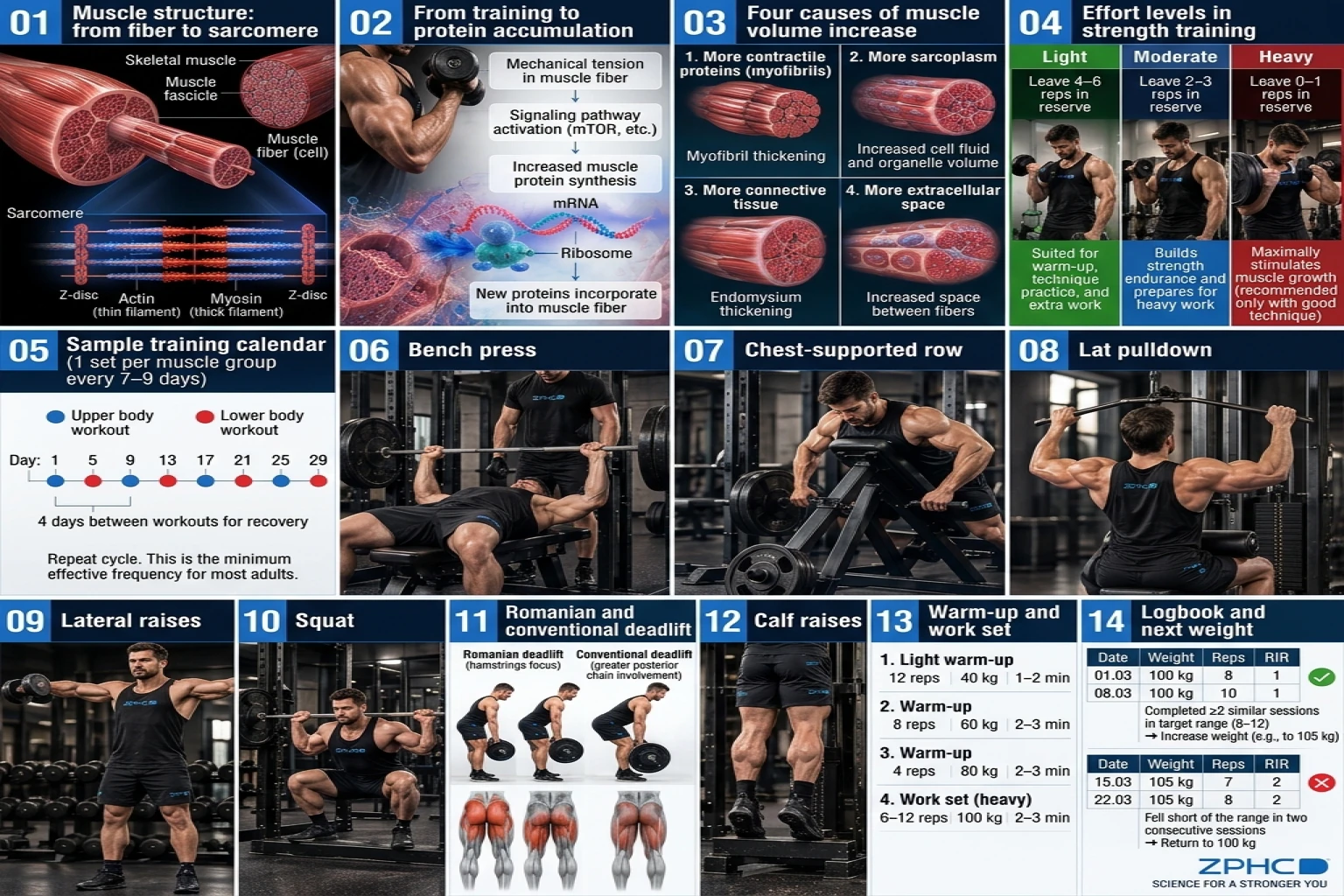
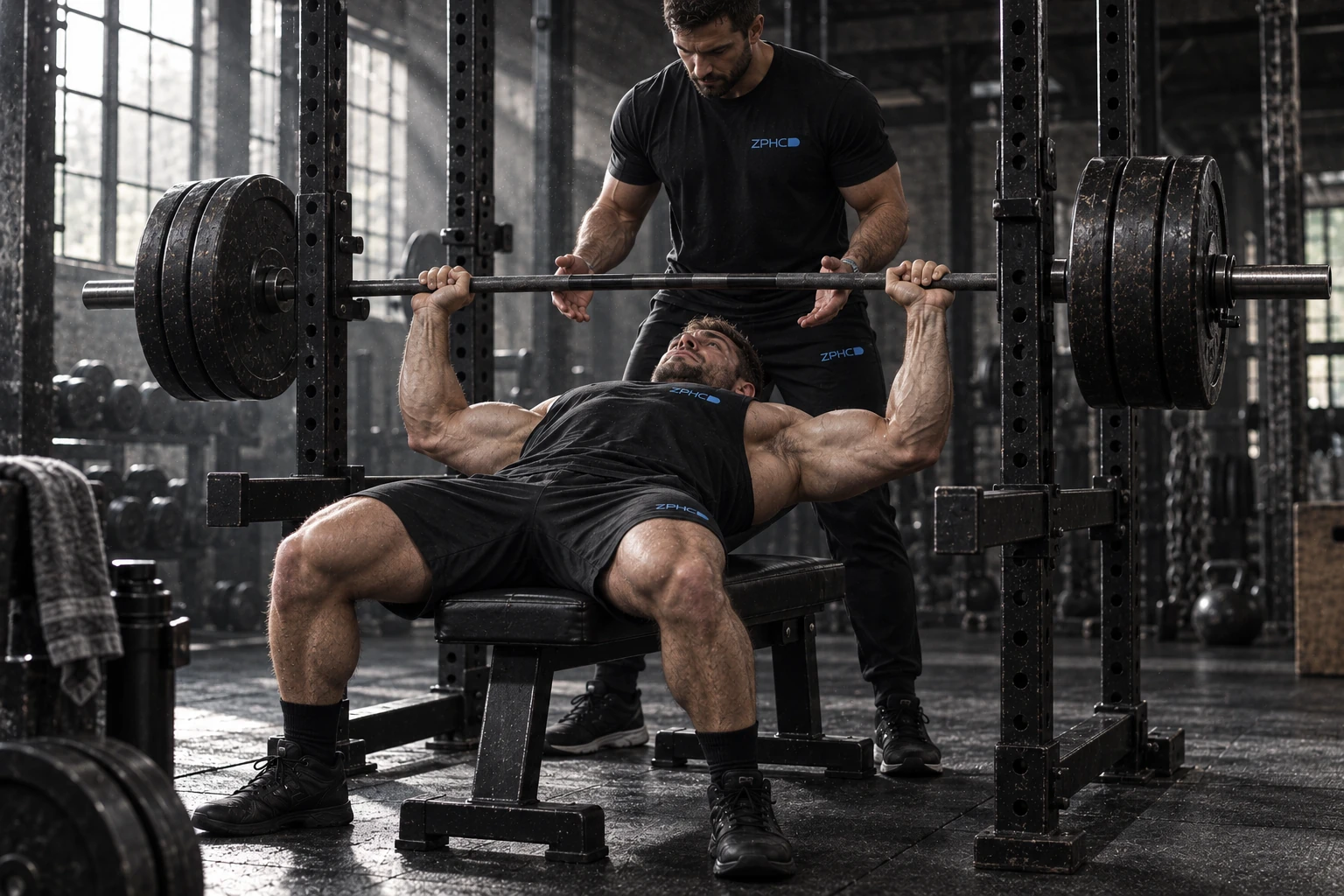
In the bench press, set up the uprights and safeties; if necessary, arrange for the help of a competent spotter. Unrack and re-rack the bar in a familiar way. Maintain your points of contact, lower under control, and press back up on your own. Bouncing the bar off your chest is not a continuation of your previous technique. The incline bench press requires its own settings, even if you've known how to flat bench press for a long time.
In the chest-supported row, the handles must be reachable without pulling your torso out of a stable position. Pull and return the resistance while keeping contact with the support. If you have to lift your chest further and further off the pad for the next rep, you defeat the original purpose of the exercise.
On the lat pulldown, lock in your thighs and pull the handle down in front of you. Do not add torso swing from rep to rep. Touching your chest is not mandatory if doing so forces you to significantly alter the movement. Lock in your chosen grip and compare it with that same grip next time.
In lateral raises, your knees can be slightly soft, with your torso leaning slightly forward. You don't have to stand like a rigid mannequin, but the chosen movement should remain recognizable throughout the set. For these routines, do not use an intentional heave of the dumbbells by extending your legs and hips. Combining a hinge with raising your arms is a separate movement; its involvement of the hips and lower back does not replace testing the load in a deadlift.
In curls, keep your wrists in a comfortable position, flex your elbows without using leg momentum, and control the return. Don't turn the later reps into a full-body barbell row. With dumbbells, maintain one mastered forearm position, rather than altering it on every rep just to keep going.
In the squat, set up the uprights and safeties in advance. Choose a repeatable depth where points of contact and control are maintained. Don't cut each successive squat a little higher just to hit your rep range. If your balance or torso position no longer matches the mastered movement, end the set.
In the Romanian deadlift, hinge your hips back with a slight bend in your knees, keeping the bar close to your legs. The bottom position does not have to be at the floor. Return by extending your hips, without violently hyperextending backward at the top. In the conventional deadlift, every rep starts from the floor after resetting your position; don't pad your numbers through bouncing and a rushed start.
Breathing and torso stabilization are learned alongside the movement. Do not hold your breath for an entire long set. If you have cardiovascular limitations, your loading and breathing strategy must be coordinated individually. A new exercise variation or a long break is a reason to retest the skill, not to rely solely on your past experience.13
Failure: why two people use one word but do different things
One person felt a strong burn and stopped. Another finished a rep and decided the next one wasn't happening. A third tried to lift the bar and couldn't. A fourth kept going with a partner's help. They might all describe their workout as going "to failure," even though entirely different events actually took place.1516
For our plan, the reason for stopping matters more than how dramatic the term sounds.
| Situation | What it means | What to write down |
|---|---|---|
| Stopped with the prescribed reps in reserve | Today's task is completed | "10 reps, about two in reserve" |
| Last rep finished, didn't attempt the next one | Assumed zero reps in reserve | "Felt like I didn't have another rep in me" |
| Continuing requires significantly different technique | Technical limit reached | "Stopped due to loss of range of motion / points of contact" |
| Started the lift and couldn't complete it unassisted | Actual failed attempt under given conditions | "Didn't complete the next rep" |
| Limited by pain, grip, breathing, fear, or balance | Other or mixed reason | Note the limiting factor rather than declaring full muscular failure |
A failed attempt is not required for a productive set. In your main work, rigorous execution with the chosen reps in reserve is enough. On the squat, both deadlifts, and the bench press, this plan does not require you to intentionally test whether you can get stuck under the weight.14
Sensations are important, but discomfort alone does not dictate how many reps are still possible. Learn to ask a specific question: "Could I have repeated this exact same movement one or two more times?" If you don't know, leave a larger margin and discuss your execution with a coach. Don't verify every prediction with an all-out attempt.
For an experienced lifter, a controlled check of this estimate can sometimes make sense on an appropriate exercise with a safe way to bail. It is not a mandatory stage for everyone and is not prescribed just because a certain week has arrived.
Negative reps are not a mandatory continuation
A controlled lowering of the weight remains part of a normal repetition. It is a different story to do extra negatives after failure, when a partner is already helping you lift the bar. That is a separate method, not the hidden second half of a work set.
Post-failure negatives are not programmed in these routines. Do not add them once a month or once a season for the sake of special "protein growth." Specialized eccentric work requires a distinct goal and setup; its infrequent use does not in itself prove any added benefit.25
What a single session looks like from walking into the gym to walking out
Take A1. You are not here to test whether you can get more tired today than before. Open your previous log for the bench press and look not only at the weight, but also at the reps, reps in reserve, grip, and the conditions of the lift.
Set up your equipment. Do your usual general warm-up, followed by light and short feeder sets for the press itself. Let's assume your warm-up went as usual, and you completed ten working reps, leaving about two in reserve. Rack the bar and log the result. Don't add a second work set just because ten didn't look impressive enough.
After resting, move on to the chest-supported row. This exercise has its own base of support setup and its own light warm-up. Perform the set according to your card. Then, prepare for lateral raises and curls in the same way. Their resistance is not selected based on your fatigue after the press: each exercise must hit its own range and reps in reserve.
If you got eleven reps on curls instead of your previous twelve, it doesn't mean your muscles have shrunk. Log the difference. Perhaps the previous row was harder, your rest was shorter, or the movement was stricter. Before drawing a conclusion, you need comparable conditions.
After the fourth exercise, your main work is finished. You might still have enough energy to calmly leave the gym and go about your normal life. This is normal. A completed prescription does not become useless just because you didn't drive yourself to total helplessness.
When to follow the plan, when to scale back, and when to stop
How you feel is not an obstacle to the program, but a piece of information. But a single signal doesn't always explain the cause. Reluctance to get ready for the gym, a hard warm-up, local soreness, and unusual general weakness are not the same thing.22
Pain, illness, or unusual symptoms
Don't test the problem with a hard set. Stop the aggravating work. If you have recurring or increasing pain, or unexplained severe weakness, get a qualified assessment. A light card is not a medical treatment.
Normal fatigue without alarming signs
Test your light warm-up. If your movement is stable but you are clearly not ready for the main effort, perform today's card in a light mode: one set per exercise, with about 4–5 reps in reserve. If your usual control doesn't return, postpone the working portion.
Normal well-being and performance
Follow the prescription. Don't add work because of an unexpected burst of enthusiasm, and don't cancel it automatically just because you lack excitement today.
If you experience chest pressure or pain along with unusual shortness of breath, cold sweat, nausea, or lightheadedness, stop the session and call for emergency help at your local number. Do not finish your remaining exercises first.27
What to do with the queue after a postponement
If you ended up doing a light B2 instead of a regular B2, it still takes its place: the next card is an upper-body one. Do not repeat a heavy B2 tomorrow in an attempt to make up for the dropped effort. If the session didn't happen at all, this same card remains next.
After a session is actually completed, plan your usual interval again, rather than trying to catch up to the previous date. If your poor condition persists, the calendar does not grant you permission to return to the main work. If postponements have become constant, the problem is no longer about schedule accuracy: you need to review your volume, effort, exercises, and potential causes for the decline.
A single bad workout does not establish overtraining. A prolonged drop in results coupled with declining well-being requires a more serious review, including ruling out other causes. Don't explain away every such condition with the formula "my nervous system hasn't recharged yet."22
Increase the load in a way that lets you understand what improved
A training log is not for proving your strength daily, but for comparison. Log the exercise, settings, working weight, number of full reps, approximate reps in reserve, and the reason for stopping. Note your warm-up separately. One additional line about the overall difficulty of the session is usually enough.
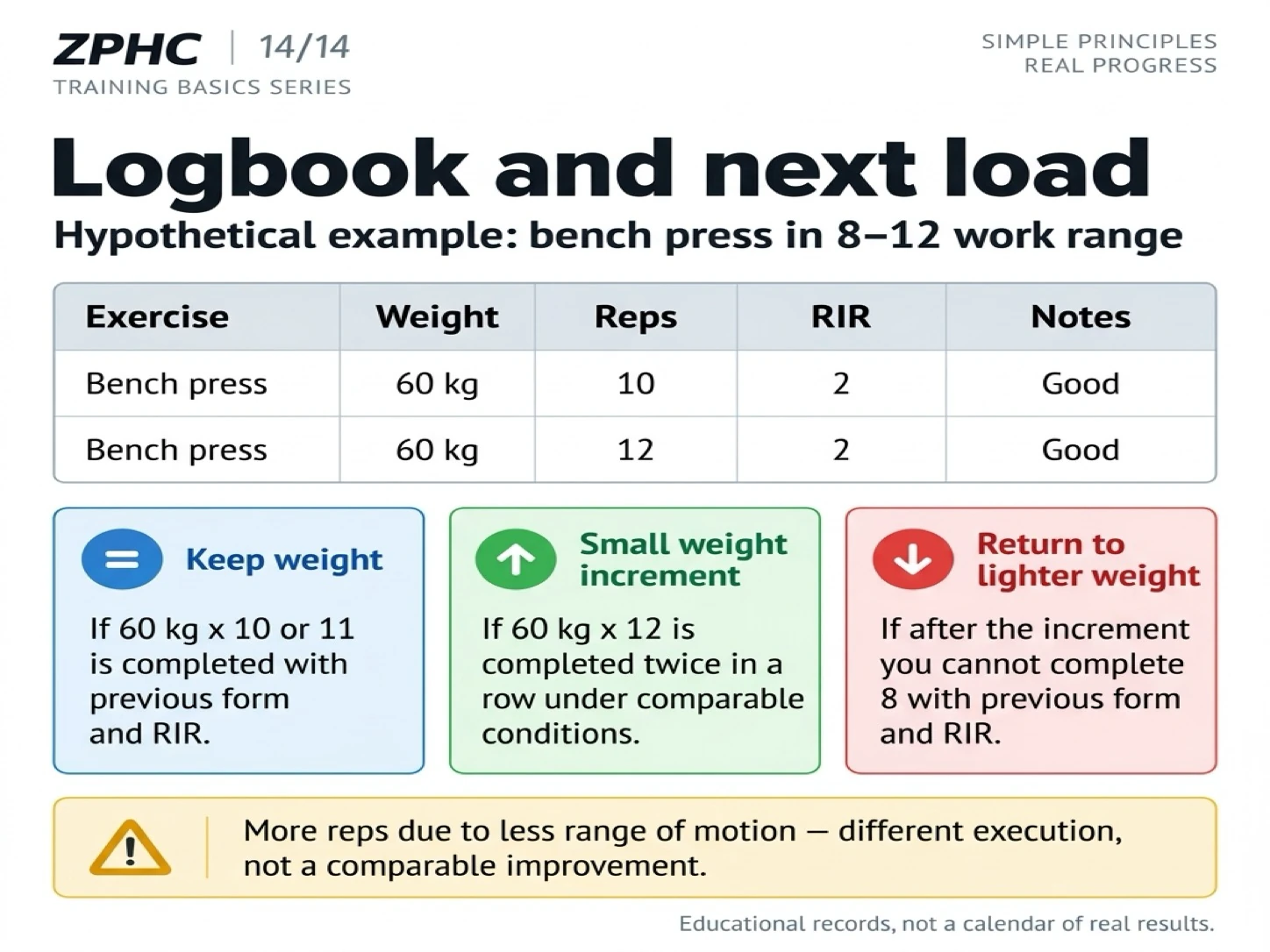
Example: "A1. Press, same grip and bench. Warm-up: 20 × 8, 35 × 5, 50 × 3. Work: 60 × 10; about two in reserve; finished as planned. Session overall normal." All numbers are hypothetical.
In this plan, you first secure the reps, then increase the resistance. When you hit the upper limit in two consecutive comparable performances with your previous technique and reps in reserve, try the smallest suitable weight increment. This is a rule of observation, not a specific physiological timeframe.
| Log entry for press 8–12 | Next action |
|---|---|
| 60 kg × 10, then 60 kg × 11; reps in reserve unchanged | Keep the weight |
| 60 kg × 12 twice under identical conditions | Try a small increment in resistance |
| After the increment, you got 9 with the same reps in reserve | The new weight meets the target |
| After the increment, you can't get 8 without losing reps in reserve | Return to the lighter weight |
| More reps, but range of motion is shorter | Do not consider the conditions identical; restore proper movement |
Compare a bench press to a bench press, an incline bench press to an incline bench press, and a squat to a squat. Moderate and light logs do not automatically trigger a load increase for your main regimen. If you squatted deeper today, that might be a beneficial change, but you now have a new baseline for comparison.
Don't demand improvement in every session
Sleep, nutrition, prior work, and errors in estimating reps in reserve all affect a single performance. Two identical results in a row are not a malfunction. And a single record achieved through a more maximal effort does not prove that the muscle has already grown.
But "you just need to wait" shouldn't become a permanent answer either. After a few comparable performances without changes, check whether the load is actually hitting the desired range and how regular your sessions are. Don't add a set just because one photo hasn't changed.
After 8–12 weeks, review your log, your tolerance, and the longer-term trend in your measurements. This is a time for evaluation, not a deadline for guaranteed gains. If there is an infrequent rotation of specific movements, you will have few entries: for example, three conventional deadlift performances do not yet provide a detailed picture. This infrequency itself might be a reason to make your exercise selection more stable.
If you are satisfied with the results, keep going. If the changes are insufficient, but your movement, nutrition, and recovery are in order, don't try to salvage a low amount of work by going to increasingly extreme failure. You can increase the frequency of the needed movement or add one work set to one priority exercise. Choose a single change with your coach, leave the rest as is, and evaluate it separately.18
If your well-being and performance decline, don't start by adding work. First, reduce its difficulty or volume and find out the cause. An insufficient stimulus and an excess of load sometimes look identical in a single line of your log, but they require different actions.
What happens between workouts
Protein structures aren't built solely thanks to a correctly chosen exercise. You need amino acids and energy. This is no reason to turn your diet into a complex system, but without a consistent diet, it's hard to understand why your training is or isn't producing results.23
For a healthy adult engaged in strength training, a practical benchmark is 1.6–2.0 g of protein per kilogram of body weight per day. At 75 kg, that's 120–150 g of protein a day. We are talking about the protein content in your food, not the same weight in meat or cottage cheese. Distribute protein-rich foods across your usual meals. A special supplement is not necessary.28
Don't try to cram all your food into a short window after your last set. The following day matters too. If you regularly undereat, lose weight unintentionally, and have trouble tolerating your normal workouts, check the adequacy of your diet. However, an identically large caloric surplus is not required for everyone.29
Carbohydrates do not replace amino acids in contractile proteins. However, they do maintain your muscle fuel reserves. Cutting out carbs is not a way to grow a "more real" muscle. A drastic change in their amount merely adds fluctuations in fullness, which are easy to mistake for tissue changes.8
In cases of kidney disease and other conditions that alter dietary requirements, protein intake and nutrition should be coordinated individually. A universal sports chart does not replace a medical prescription.
Sleep cannot be compensated for by one light workout
Lack of sleep can interfere with recovery and muscle protein synthesis. If it has become chronic, this is an issue in its own right, not a reason to keep cutting back your exercises more and more while continuing to live in the same routine.30
Try to maintain a regular sleep schedule, allow enough time for nightly rest, and take note of persistent daytime sleepiness. In case of severe or prolonged problems, investigate the cause. A training log doesn't replace a sleep assessment, and strength training is not a means to "override" sleep deprivation.
How to look at your results without self-deception
Take photos and circumference measurements under identical conditions: before a workout, with your usual nutrition and hydration, using the same pose, lighting, and measurement spots. A few weeks between such checks is more useful than a daily comparison of fullness. Evaluate your body weight based on multiple morning measurements, not a single weigh-in after eating.
Neither a photo, nor a tape measure, nor a new weight on the bar determines the grams of new actin and myosin. Strength has a technical component; appearance is affected by lighting and fluid. Look at three things together: what you are capable of performing with high quality, how you tolerate the sessions, and how your measurements change over time.189
A good program leaves room for the next workout
You don't have to choose between two extremes: leaving the gym completely broken every time or spending your whole life working with virtually weightless loads. Between them lies consistent strength training — hard enough for the muscles and manageable enough for the person.
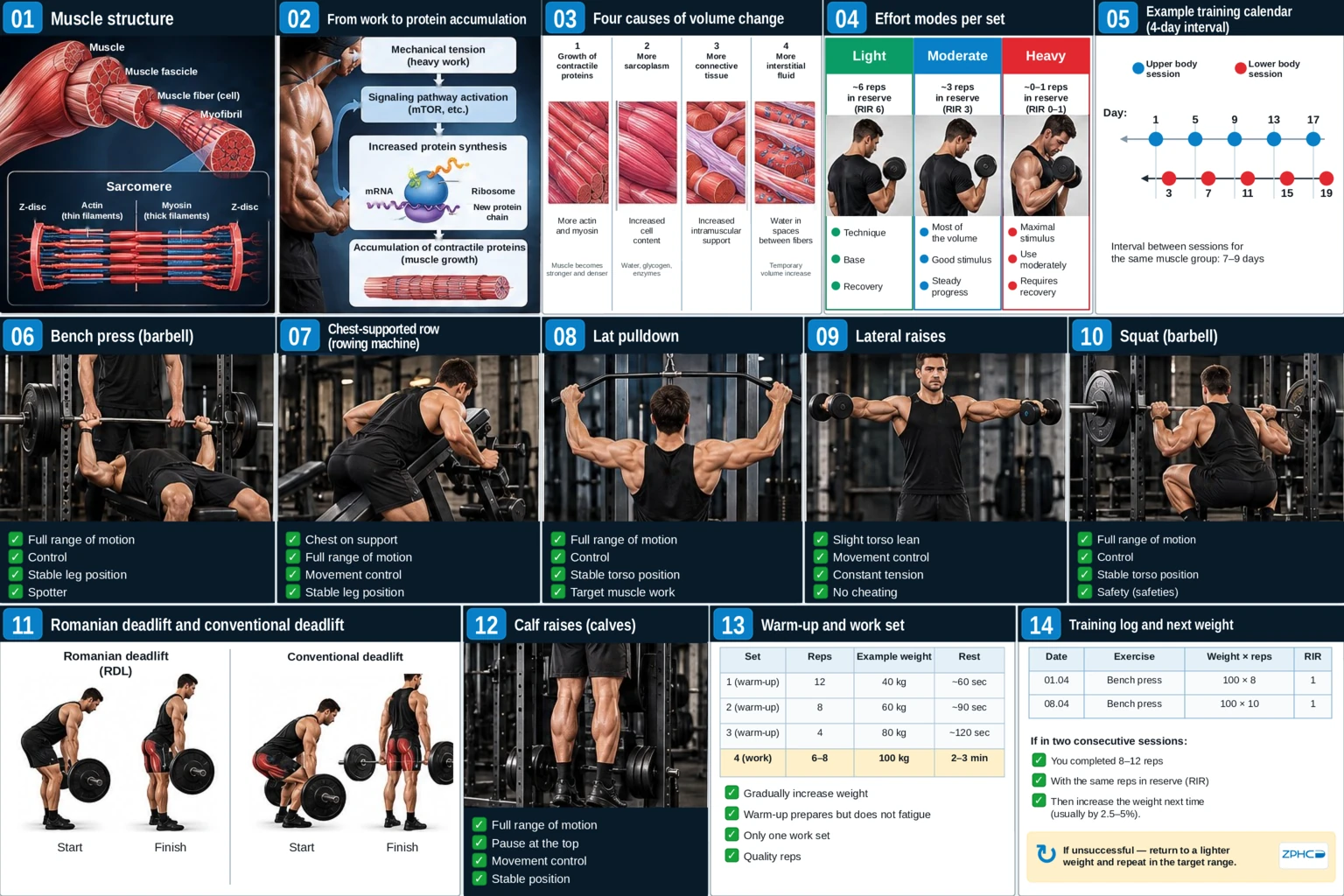
An upper/lower split makes sessions shorter. Alternating squats and deadlifts limits the combination of high demands on a single day. Warm-up sets help you build up to your working weight. A small margin of reps in reserve allows you to end a set before it turns into a different movement. These are all tools, not a promise that this exact combination will suit everyone.
The most important part of the plan is the willingness to look at the results without clinging to a beautiful idea. If there is not enough work, it needs to be reviewed. If it is not well tolerated, you cannot demand even greater persistence from yourself. If you still have to relearn the exercises from scratch, reduce their rotation and get back to practice.
At your next workout: open the next card, look at your previous log, check your condition, prepare for the movement, and execute the prescription. Stop based on a clear criterion. Log the result. Then focus on recovery and your normal life, rather than searching for yet another way to prove that you are tired enough.
Contractile structures do not accumulate from a single particularly convincing sensation. Results are created by repeatable muscular work, material for synthesis, and the time over which you manage to keep going.
Training should give your muscles work. It should not take away a person's ability to live normally and keep training.
The plan is a practical example for a trained individual, not an individualized medical recommendation or a guarantee of growth. Detailed rationale and limitations are provided in separate notes; all the actions necessary for execution can be found in the article itself.
How to train: the first 6 weeks you can print
For apparently healthy adults training without anabolic drugs who have mastered the exercises with a coach; with illness, pregnancy, injury or unusual symptoms, the load is set individually.
Upper (A) and lower (B) in turn, 4 days between session starts. Upper cards cycle A1 → A2 → A3, lower cards B1 → B2 → B3 → B4; the rotations are independent. One work set per exercise; the warm-up does not count.
Calendar for the first six weeks (days from the start)
| Week | Day | Card | Main focus in the session |
|---|---|---|---|
| 1 | 1 | A1 | Bench press, chest-supported row, shoulders, barbell curls |
| 1 | 5 | B1 | Squat, calves |
| 2 | 9 | A2 | Incline press, lat pulldown, shoulders, dumbbell curls |
| 2 | 13 | B2 | Romanian deadlift, calves |
| 3 | 17 | A3 | Repeat of the A2 lineup |
| 3 | 21 | B3 | Repeat of the squat, calves |
| 4 | 25 | A1 | Bench press, chest-supported row, shoulders, barbell curls |
| 5 | 29 | B4 | Conventional deadlift (only if mastered; otherwise learn it or agree a replacement with your coach), calves |
| 5 | 33 | A2 | Incline press, lat pulldown, shoulders, dumbbell curls |
| 6 | 37 | B1 | Squat, calves — start of the next lower-body cycle |
| 6 | 41 | A3 | Repeat of the A2 lineup |
Cards (exercises in this order; reps in reserve are for the main mode)
| Card | Exercise | Work set | In reserve | Rest after |
|---|---|---|---|---|
| A1 | Flat barbell bench press | 1 × 8–12 | about 2 | about 3 min |
| A1 | Chest-supported row | 1 × 8–12 | about 2 | about 3 min |
| A1 | Standing dumbbell lateral raises | 1 × 12–20 | about 2 | about 2 min |
| A1 | Standing straight-bar curls | 1 × 10–15 | about 2 | work finished |
| A2, A3 | Incline barbell bench press | 1 × 8–12 | about 2 | about 3 min |
| A2, A3 | Lat pulldown in front | 1 × 8–12 | about 2 | about 3 min |
| A2, A3 | Standing dumbbell lateral raises | 1 × 12–20 | about 2 | about 2 min |
| A2, A3 | Dumbbell curls | 1 × 10–15 | about 2 | work finished |
| B1, B3 | Barbell squat | 1 × 6–10 | about 3 | 3–5 min |
| B2 | Romanian deadlift | 1 × 8–12 | about 3 | 3–5 min |
| B4 | Conventional deadlift | 1 × 5–8 | about 3 | 3–5 min |
| B1–B4 | Standing calf raises with support | 1 × 12–20 | about 2 | work finished |
Build-up to the first main exercise: 8–10 smooth reps → 4–6 with slightly more weight → 2–3 closer to the working weight → about 3 minutes of rest (longer if needed) → the work set. Before the second big exercise (row / pulldown) — fewer sets, but check the setup, grip and path. Before lateral raises and curls — one light set of 8–12; before calves — 8–12 raises with no added weight or light resistance.
Effort: the first performances of each card — moderate mode (3–4 in reserve), then, once the movement and tolerance are stable, main mode; no intentional failure, bouncing, partner help to continue a set, or post-failure negatives; in the bench press use safety catches and, if needed, a competent spotter.
Adding weight: the top of the rep range on two consecutive comparable performances with the same technique and reps in reserve — try the smallest weight increment; moderate and light entries do not trigger an increase; if after the increase you cannot reach the bottom of the range without losing reps in reserve, return to the lower weight; more reps with a shorter range of motion is not a comparable result.
After 6 weeks the rotation continues: every 4 days the next card (day 45 — B2, 49 — A1, 53 — B3). A skipped session does not reset the rotation: the same card stays next, shift the calendar from it; do not cram missed work into one evening. A light card takes its normal place — move on to the next card; do not repeat it hard the next day. After 8–12 weeks, review your log and measurements: little change with technique, nutrition and recovery in order — one change with your coach (the needed movement more often, or +1 work set on one exercise); getting worse — first reduce the difficulty or volume and find the cause.
Scale back or stop
- Ordinary fatigue with no warning signs and a stable movement in the light warm-up — light mode: the same exercises, one set, 4–5 in reserve, do not shorten rest. If control does not return, postpone the work part.
- Pain, illness, unusual symptoms — do not test it with a hard set; stop the aggravating work; recurring or increasing pain or unexplained marked weakness — get a qualified assessment; a light card is not treatment. Pain in the Achilles tendon or foot — stop and investigate.
- Chest pressure or pain with unusual shortness of breath, cold sweat, nausea or lightheadedness — stop the session and call for emergency help.
- Do not hold your breath for an entire set; with cardiovascular limitations, agree load and breathing individually.
- Between sessions — regular sleep; for a healthy adult 1.6–2.0 g of protein per kilogram of body weight per day from ordinary food, no supplement required, with kidney disease or other conditions that change dietary needs — individually; keep a log.
Details are in the article above.